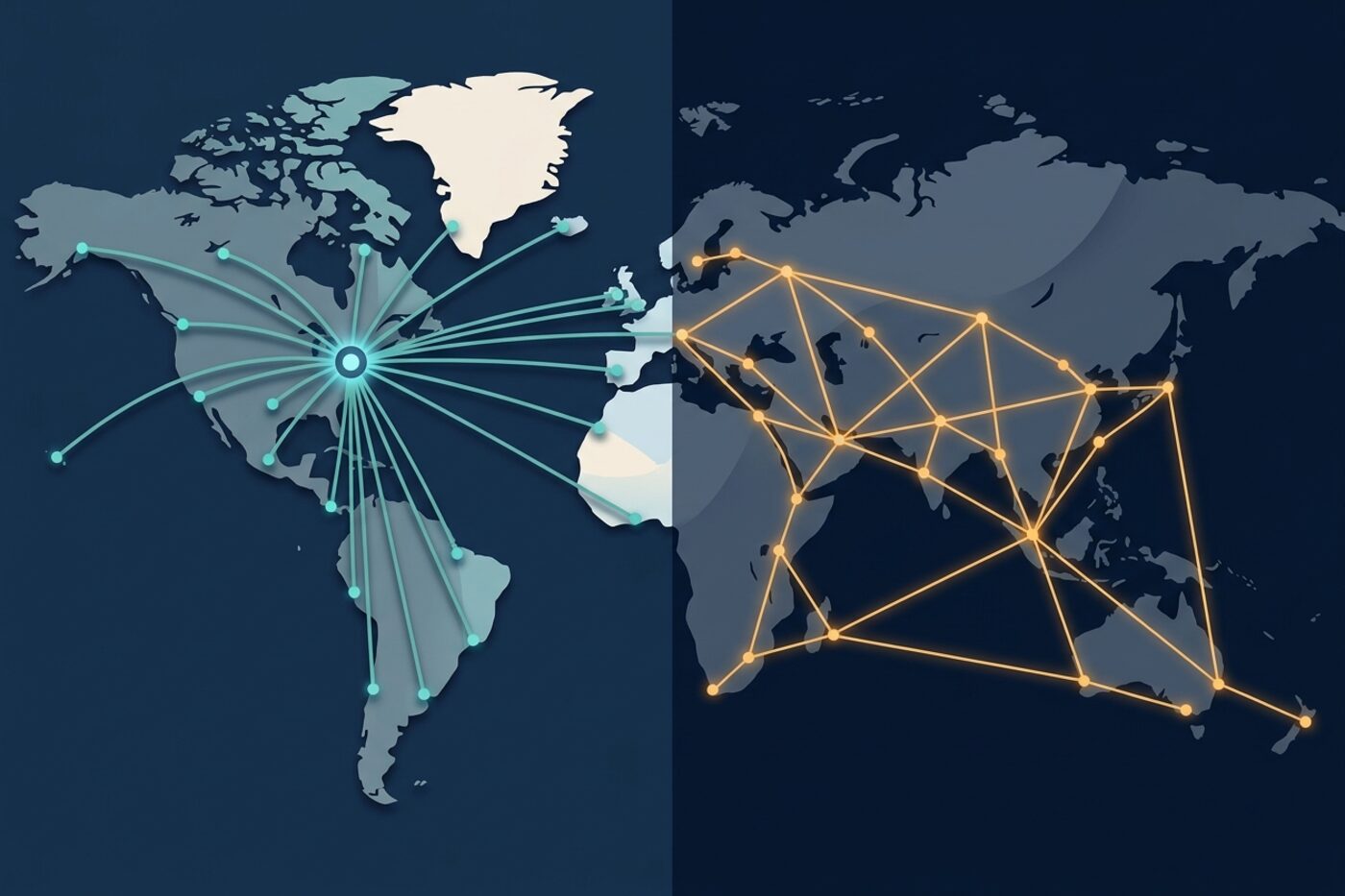
Every new virtual airline eventually has the same argument with itself: should the route map look like a real legacy carrier’s, with everything funneling through one or two hubs, or should it be a loose web of direct routes between whatever airports the founders like flying? I’ve built network maps both ways over the years, and both can work well – they just fail differently when you get the choice wrong for your specific VA.
What hub-and-spoke actually gives you
A hub-and-spoke network concentrates flights through a small number of central airports, with spoke routes feeding traffic in and connecting flights carrying it back out – the same logic Delta uses at Atlanta or Lufthansa uses at Frankfurt. For a virtual airline, the real benefit isn’t passenger connections, since nobody’s actually connecting between your flights. It’s that concentrating activity at one or two airports builds a real community there. Pilots based near or interested in your hub fly it repeatedly, get to know its layout, its typical arrival flows, and its regulars, and staff can concentrate real-world-style operational detail – accurate SIDs and STARs, gate assignments, ground handling procedures – on a manageable handful of airports instead of thinning that effort across fifty.
It also makes growth predictable. Adding a new spoke route is a small, contained decision: pick a destination, connect it to the existing hub, done. New pilots have an obvious entry point too – “learn our hub, then branch out” is a much easier onboarding story than “here are ninety unrelated city pairs, pick some.”
The tradeoff is that a hub-and-spoke network can feel monotonous if your hub isn’t interesting to fly repeatedly, and it puts a lot of weight on picking that hub well. Choose an airport with genuinely varied approaches, a mix of short and long spoke distances, and reasonable ATC coverage on VATSIM or IVAO, and the repetition stays engaging. Choose a flat, procedurally simple airport and repetition becomes the thing that drives pilots away.
What point-to-point actually gives you
A point-to-point network – closer to how Southwest or easyJet actually operate in the real world – links city pairs directly without funneling everything through a central node. For a VA, the appeal is variety: pilots aren’t tied to one home base, the route map can follow whatever real-world city pairs the founders and members find interesting, and it’s easier to add a route that has nothing geographically to do with your existing network.
This structure suits a VA built around a specific aircraft type or a themed identity – a 737 or A320 narrow-body operation modeling a specific real airline’s actual route list, for instance – more naturally than hub-and-spoke does, since real low-cost and regional carriers are usually point-to-point themselves. It also lowers the barrier for members scattered across different time zones and regions to each fly routes local to them, rather than everyone needing to touch the same hub airport.
The tradeoff is coordination. Without a shared hub, there’s less natural overlap between pilots’ schedules and less of the organic community-building that comes from repeatedly seeing the same people at the same airport. Group events need more deliberate planning since there’s no default gathering point, and new pilots don’t have as obvious a starting question as “which spoke do I want to try first.”
Fleet planning follows the network, not the other way around
The route model you pick also quietly decides your fleet needs, which is easy to overlook when you’re first sketching a route map. A hub-and-spoke network with short regional spokes and a handful of long-haul routes out of the hub wants a mixed fleet – something like a regional jet or turboprop for the short legs and a wide-body or long-range narrow-body for the marquee routes. A point-to-point network built around one aircraft type stays simpler to manage because every route uses the same performance numbers, the same checklist flow, and the same type rating requirement for pilots, but it caps how far your route map can stretch before the aircraft’s range runs out.
This is worth deciding early rather than backing into it. A VA that bolts a single long-haul route onto an otherwise short-haul point-to-point network, purely on member request, often finds it sits underflown – it doesn’t fit the identity pilots signed up for, and it needs an aircraft type most of the roster isn’t rated on.
A reasonable middle ground
Plenty of successful VAs land somewhere between the two: a primary hub that anchors community and staff attention, plus a secondary layer of point-to-point routes that don’t touch the hub at all, aimed at pilots who want variety or who are geographically distant from it. This mirrors how real airlines with a dominant hub still operate some direct regional or leisure routes that skip it entirely. It costs more in route-planning effort than picking one pure model, but it lets you capture the community benefit of a hub without forcing every member into the same routing.
Deciding for your own VA
The honest deciding question isn’t which model is objectively better – it’s genuinely situational. If your founding group is concentrated around one region or one airport everyone enjoys flying, hub-and-spoke will build community faster. If your identity is built around a specific real airline’s actual operation or a specific aircraft type flown globally, point-to-point will feel more authentic and keep your route map interesting longer. Look at how Flightradar24 visualizes a real carrier whose model you admire, trace out how their network actually distributes traffic, and you’ll usually find the answer to which structure fits the identity you’re trying to build before you’ve written a single route into your database.